


SpaceX has successfully launched and landed Starship, the spacecraft designed to carry humans across the solar system in the future.
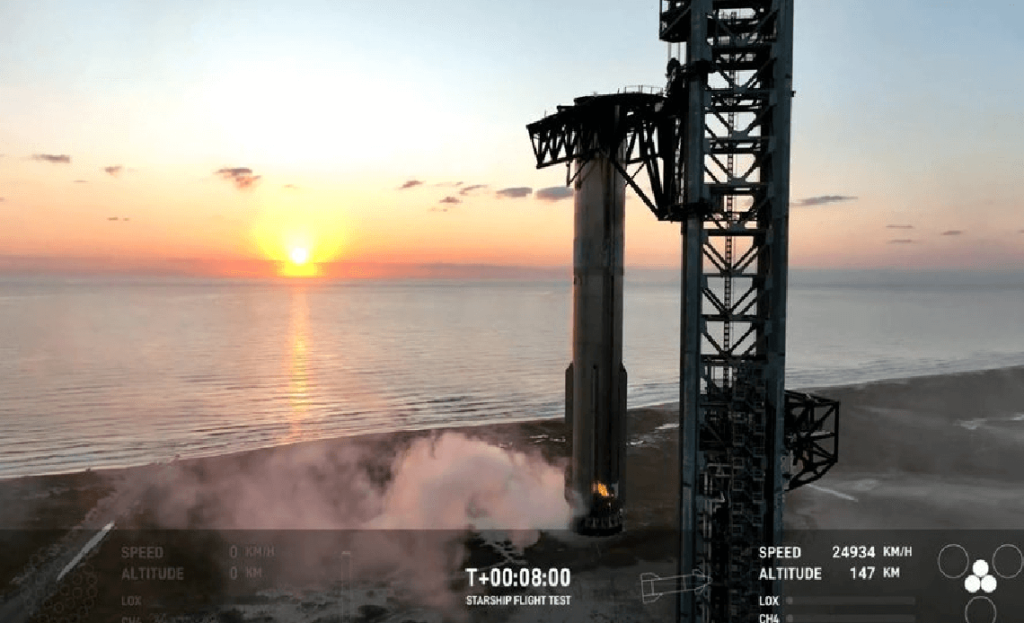
In a remarkable achievement, SpaceX employed mechanical arms, dubbed “chopsticks”, to catch the booster upon its return to the launchpad to reuse it.
According to a source from the Associated Press.
The primary section of the spacecraft—also named Starship and intended to eventually carry people—entered orbit before descending for a splashdown in the Indian Ocean.
Starship is the most powerful rocket ever constructed, and SpaceX, led by chief executive Elon Musk, envisions it one-day transporting humans to the Moon and Mars.
At nearly 400 feet tall, the uncrewed Starship lifted off at sunrise from the southern tip of Texas, close to the Mexican border.
It soared over the Gulf of Mexico, following a path similar to four previous Starship launches, before ending in the sea.
The latest test flight in June was the most successful so far, finishing its mission without any explosions.
This time, SpaceX founder Elon Musk raised the stakes and the level of risk.
The first-stage booster returned to the launchpad just seven minutes after liftoff. The launch tower was equipped with massive metal arms—nicknamed “chopsticks”—which successfully captured the 232-foot booster as it descended.
Speaking near the launch site, SpaceX’s Dan Huot expressed his excitement by exclaiming, “Are you kidding me?” He added, “I am shaking right now.”
Kate Tice, speaking from SpaceX’s headquarters in Hawthorne, California, commented that “this is a day for the engineering history books.”
The flight director, who had manual control, made the decision to attempt the booster catch in real-time.
SpaceX stated that both the booster and the launch tower had to be in optimal condition for the landing attempt. If not, the booster would have ended up in the Gulf, as in previous tests. However, everything was deemed ready for the catch.
After separating from the booster, the stainless-steel spacecraft continued its orbit around the Earth, aiming for a controlled splashdown in the Indian Ocean.
The June test flight fell short, with components detaching during re-entry. SpaceX has since upgraded the software and enhanced the heat shield’s thermal tiles.
For the past nine years, SpaceX has been recovering the first-stage boosters of its smaller Falcon 9 rockets, which deliver satellites and crews to orbit from Florida and California.
These boosters either land on ocean platforms or concrete pads a few miles away from the launch site – not directly back on the pad.
Reusing Falcon boosters has allowed SpaceX to accelerate its launch schedule and save millions of dollars.
Elon Musk plans to apply the same reuse strategy to Starship, the largest and most powerful rocket ever built, with 33 methane-fuelled engines on the booster alone.
NASA contracted two starships to land astronauts on the moon later this decade.